You and Kelly founded the SMWS chapter in Canada. What made you go from sharing whisky to making it?
I think the craft of whisky making is fascinating; for only three ingredients (plus time), there can be so much variation. So from being introduced to single malt in 2004 when Kelly and I lived in Scotland for a year, I had always been interested in what was possible in whisky creation.
SMWS is the ultimate exploration in flavour for whisky drinkers. My thinking in terms of a distillery was: why does all scotch whisky have to be made in more or less the same way? Why can't a whisky distillery be an exploration of flavour? I think a lot of that approach is because I don't come from the industry; I'm an outsider and don't have years of thinking about scotch in one way. And my co-founder, David Robertson, was also very open to new approaches.
So Holyrood really is a lot about trying to look at whisky production in a different way. That's really the goal. It's been interesting because we're not following anyone else here but very much forging our own path.
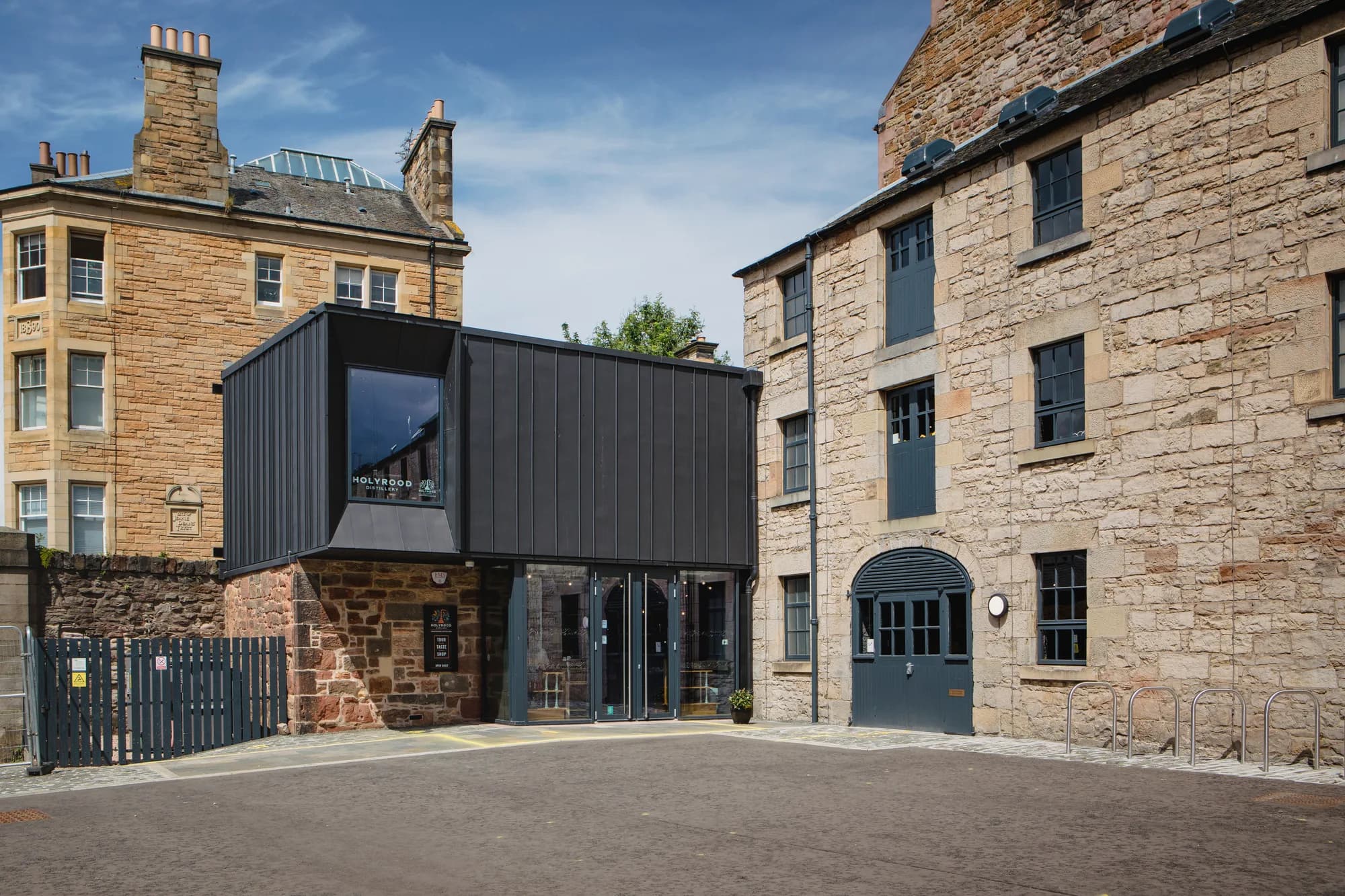
Holyrood is Edinburgh's first single malt distillery in around 90 years. Why Edinburgh, and why now?
Kelly and I love Edinburgh; after living there for a year from 2004 to 2005 we took annual trips back. Part of this was to pursue the Canadian chapter of SMWS; that took five years from first expressing interest in launching a branch in Canada in 2005 to actually being offered the SMWS chapter in 2010, and then launching in 2011. But a big part of those trips was just because we love the city.
After initially looking at developing a distillery in Calgary as well as a couple of other approaches, I was still keen on developing something. I gave a lot of thought to location and became very focused on Edinburgh because: 1) it is the second most visited tourist city in the UK and I wanted to lean into hospitality for brand engagement and revenue; 2) it didn't have a single malt distillery at the time and we felt we could do something very new and different; and 3) Kelly and I love the city (worthy of repeating).
You bring an experimental approach to flavor. What are you doing that traditional Scotch doesn't?
My family has a strong streak of contrarian, and so I was never interested in making whisky the way other people do it. And if you're going to build an independent distillery then you'd better have something unique about it.
The vast majority of whisky made in Scotland is made with the same pot still single malt and the same distilling yeast. This makes perfect sense for the big producers as their brands must tick the box for consumers in terms of the predictability and consistency of their various products (12 year old, 15 y/o, etc.). And using the same pot still malt and the same distilling yeast also means they get the best efficiency out of their production, so they make spirit as inexpensively as possible.
Holyrood doesn't take this approach. We have certainly produced with the same malt and yeast as our bigger peers, but we will often add small proportions, perhaps up to 10% of the mash bill, of specialty malts. These are malts more typically used in brewing beer; things like chocolate malt, caramalt, brown malt, etc. In addition to using different malts, we also use different yeasts; yeasts are a very underappreciated contributor to flavour in whisky; we use different beer yeasts, wine yeasts, etc. And then we have a pretty interesting cask programme on top of all that.
Why do we do this? It's slightly more expensive, but that's worth it for us because we want to create flavour throughout the production process, from mashing, through fermentation and then in how we run our stills. You'll rarely hear the big producers talk about the type of malt and yeast they use whereas on a Holyrood tour we'll bang on about it until your head spins. And you'll never hear us say that 70% of the flavour of Holyrood whiskies comes from the cask, because it simply isn't true for us. We intentionally create flavour right from beginning; it's whisky as it could be, not as it should be.
If that wasn't enough, we also love using heritage malts. These are malt varieties that have fallen out of favour in the distilling industry because they aren't as cost effective as modern malts. Old malts like Chevalier, Plumage Archer and Golden Promise bring different flavours and mouth feel.
What this gives us is a vast spectrum of flavour in the warehouse from which we can put together really interesting single malts that have great complexity.
Tell us about Arrival, your first single malt. What did it feel like to finally release it?
The inaugural whisky from a distillery is always special, and Arrival for us was a great way to introduce Holyrood whisky and our unique approach.
It was my observation that a lot of new distilleries release their inaugural whisky and whisky fans buy it, try it and then it sits on the shelf. I wanted our inaugural whisky to be something that people would finish a bottle of and want to buy again. Our approach to flavour allows us to do this because we can create a whisky that is much more complex at a younger age. I was really pleased that we had very experienced whisky people telling us that Arrival tasted more like a 12 to 15 year old then what is was, which was essentially a 3 1/2 year old.
Having David Robertson, formerly of Macallan, on board must matter. What has he brought?
David is a huge part of what Holyrood has become. I wanted Holyrood to be different but he really took that vision of flavour and took it to the next level with designing and implementing a production programme using specialty malts. Our distillers have taken that foundation and built on it and have learned an enormous amount along the way.
I view David as quite unique in the whisky world. He essentially grew up in the industry but has never accepted that the tradition of scotch whisky was the only way. He's always pursued his own path and that approach is a good reason why Holyrood pursues its own path.
You're now available in the US. What do you want American drinkers to know about Holyrood?
Any whisky drinker, whether they be in the U.S. or elsewhere, needs to appreciate that Holyrood has a very different approach a compared to traditional brands.
The scotch industry has been very good at training consumers that every scotch whisky distillery must have its own 'style', i.e. it's own flavour lane, and that the 'style' must be reflected in age statements.
So to see Holyrood, with non-age statement releases like Embra, Ambir and Pitch reflecting different flavours, is very unusual and I think it's challenging for a lot of consumers.
I believe that the fundamental attribute of whisky is flavour. That's why we drink it, right? Because we enjoy it. For me, and perhaps some of this is the influence of SMWS and other independent bottlers, the age of a whisky is irrelevant when it comes to flavour. In fact, I'm a huge fan of blind tastings where there's no data available other than what your nose and palate provide. You can often find yourself surprised by liking something from a distillery that was never high on your list before simply because you tried the whisky without preconceptions.
So for U.S. and other consumers, look at Holyrood as exploration. We are offering consumers an opportunity to explore a very different way of creating and releasing whisky. And if you like the flavour, who cares how old it is?

How do you appeal to younger drinkers who find Scotch intimidating or old-fashioned?
Holyrood is very much about forging our own path. We have huge respect for the traditional distilleries in Scotland and they make fantastic whisky, but that traditional approach just doesn't work for the Holyrood team. The Holyrood team are Scottish to the core, but the bens and glens and antlers are just not our thing.
Our approach is that we take our whisky very seriously but we don't want to take ourselves too seriously. We love to bring a bit of fun and be a bit irreverant and self effacing (perhaps the latter quality is a bit of a reflection of the Canadian influence in the business).
Our newest whisky, Smoulder, is a great example. It's a lovely whisky and we've received all kinds of accolades for the liquid, but a big part of it is the fun storytelling. Whisky is often approached so seriously and that is intimidating for people who are just curious about the category; why not have a bit of fun? Whisky is about sharing and enjoying together, after all, and if Holyrood can spark a laugh or a joke, even if the joke's on us, then great.
So we'll continue to have some fun and if that lowers the intimidation level for consumers, of any age or gender, when they're looking at Holyrood then we will have accomplished our goal.
What's the biggest myth about Scotch you'd like to bust?
AGE STATEMENTS! That older whiskies are better. I once had a lady come up to an SMWS table that I was working at a whisky festival and she flatly refused to try anything less than 15 years old. I was quite saddened; there are so many great whiskies out there that are less than 15 years old.
Explore and try different things. You don't have to buy the whole bottle; go to tastings - it's a great way to try new things and the upside is that you'll meet some great people who share your interest and are often really helpful, particularly for people just getting into whisky. Often stores will have a bottle open for you to try as well. Invest your hard earned money in something that you enjoy (and hopefully share!), not just because it has the right age statement.
How should people taste Holyrood: neat, with water, or in a cocktail?
However you like. If it's in your glass, it's your whisky so enjoy it exactly how you like.
If you're not making a cocktail and looking to try a new whisky, I would always encourage people to try the whisky neat before they add water. You don't need to try very much; just a couple of drops will usually be enough, particularly if it's a higher alcohol level. And then if you do feel it needs water, add just a bit of water at a time until the whisky is where you want it as you can't take the water out again.
What's your favorite thing to do in Edinburgh after a day at the distillery?
The business in pretty all consuming so there's always something to think about or work on. But I do like to grab a couple of pints at a traditional pub once in a while and read; that said, usually my brain is working on something in the background so I'll go back and forth between reading something and capturing some thinking about one thing or another.
What's the best cigar or food pairing with your whisky?
Tough question. Holyrood does small batch releases, each with different flavours, so the same answer won't necessarily apply in the sense that one cigar might pair well with an Ardbeg, for example.
Broadly speaking, just as cheese is a great overall pairing for most beers, chocolate is a great pairing that will go with almost any whisky.
What's the next big experiment at Holyrood?
We are looking at our first core release in 2027. This will be a continuing product that's always available. It definitely won't be Holyrood trying to mimic another distillery's core release or styl; it will very much be a Holyrood whisky, with our innovation and unique approach behind it.
You heard it here first.
Alongside that you'll see continued small batch releases.
But first, the U.S. will get Smoulder, our latest small batch release. Smoky and sultry. Let us know what you think!